Creating Hiisi |
For a long time, I understood Hiisi the way many of us do today. As something close to an ogre, a devil, or a dark creature from old tales. It was not a concept I felt drawn to, and it certainly was not something I thought had anything to do with my work.
That changed when I began to learn that Hiisi, in its older meaning, is not a creature at all, but a place. A wild and powerful forest area, often a hill or ridge, associated with untamed land, boundaries, and a presence that existed long before human control. That understanding made sense to me. It did not feel exotic or spiritual. It felt familiar.
And then I realised… this is where I live!
Our home rests on a hill, wrapped in trees and pressed against a ridge. The hill is called Hiisi Hill, (Hiismäki in Finnish). Our property is registered as “Northern Hiisi Hill”, and our road is called “Hiisi Hill Road.”
The forest here is young, only a few decades old, but the land itself is ancient. Long before farm fields, roads, and houses, I believe this place already was Hiisi, and in many ways, still is.
That I ended up living here, working with wood, inspired by Finnish forests and nature, drawn to old stories and imagined worlds, … this no longer feels like coincidence! It feels like a returning. A quiet turning back toward something older. And with that came a need to share what Hiisi once was, before it was reshaped into something fearful.
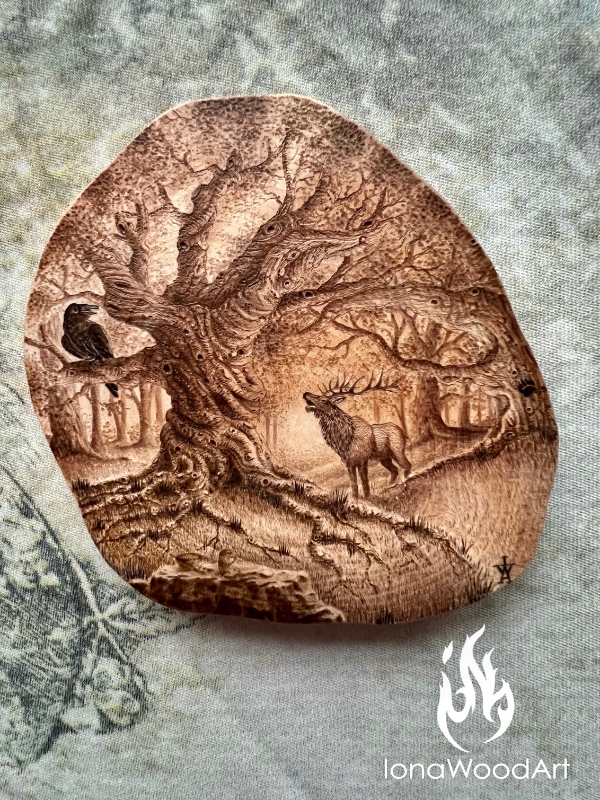
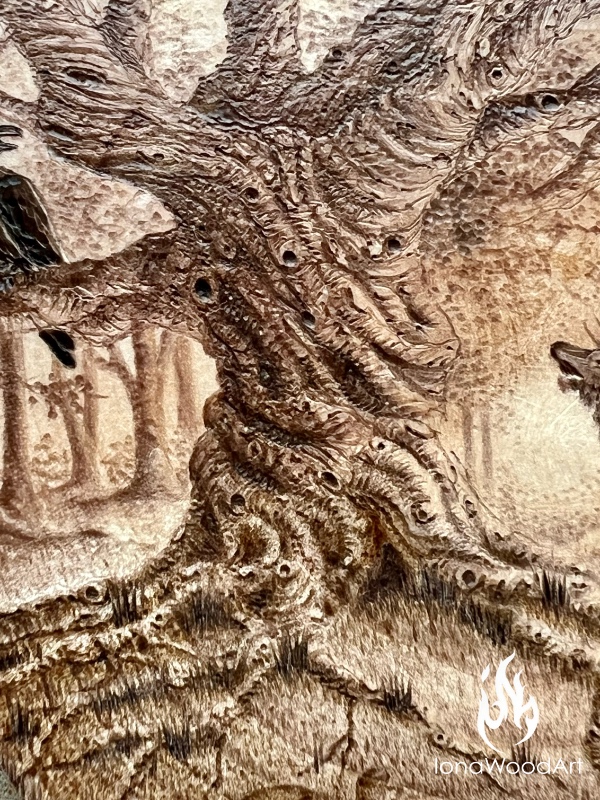
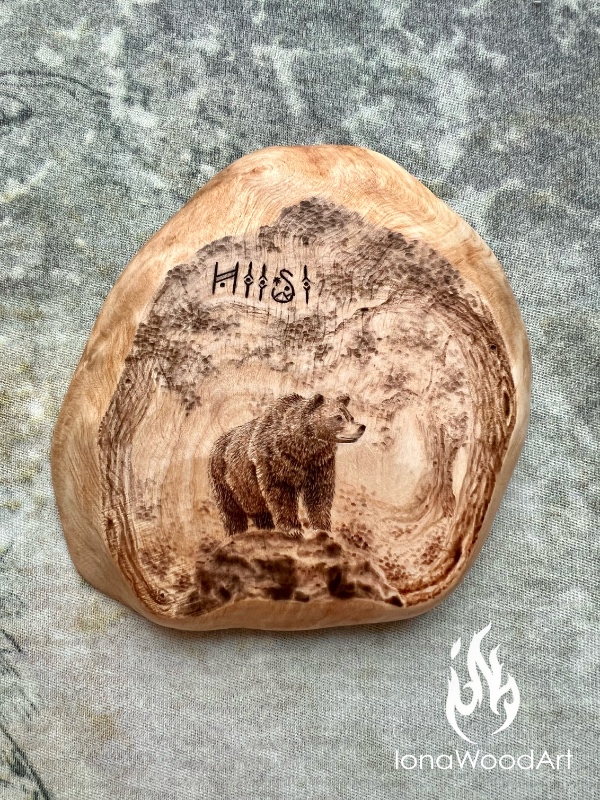
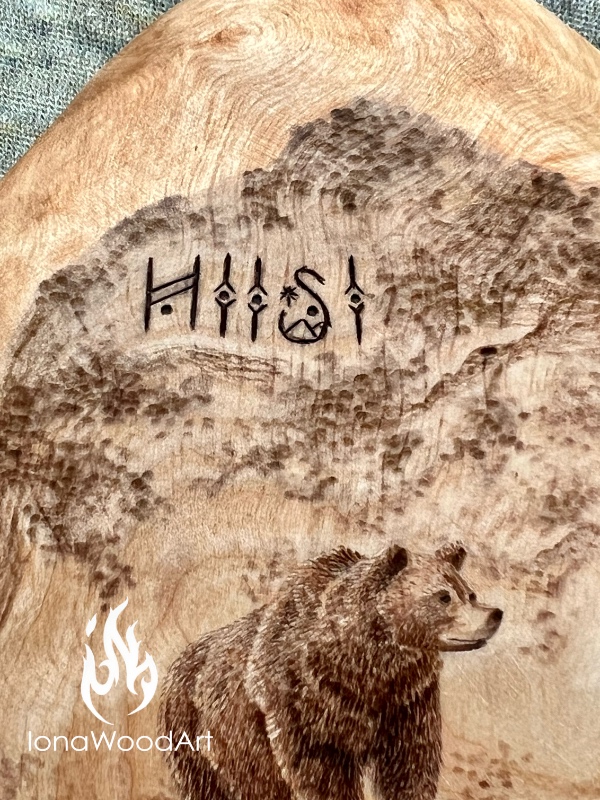
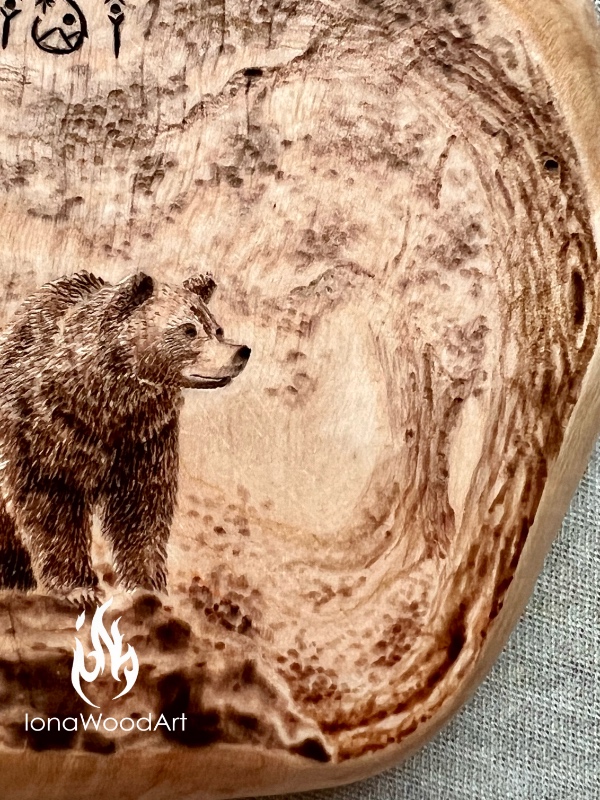
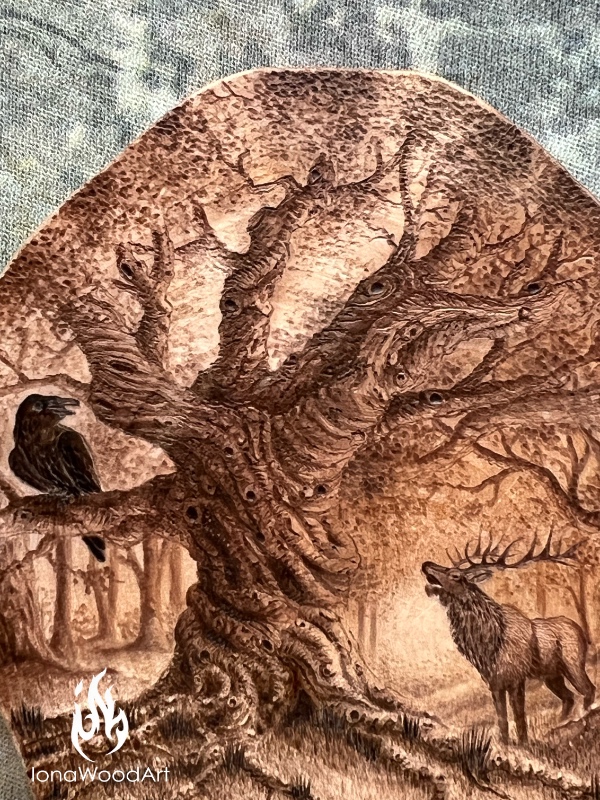
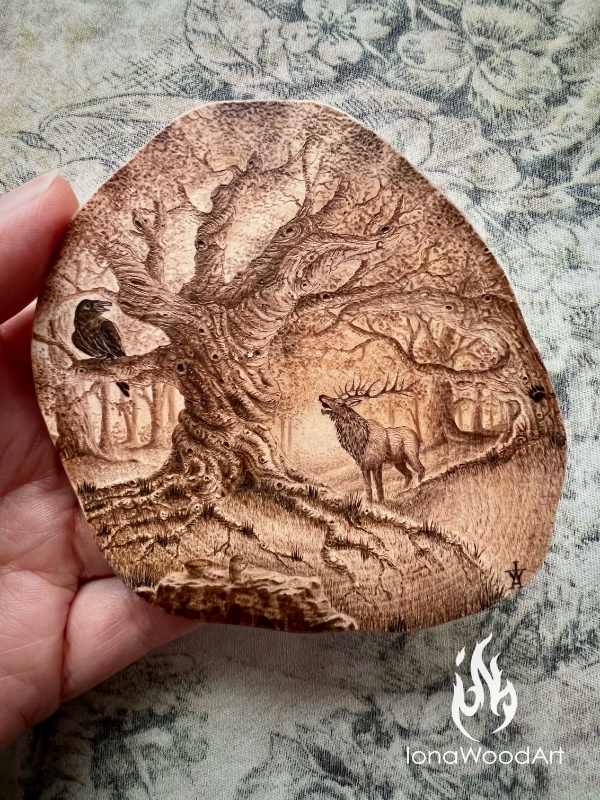
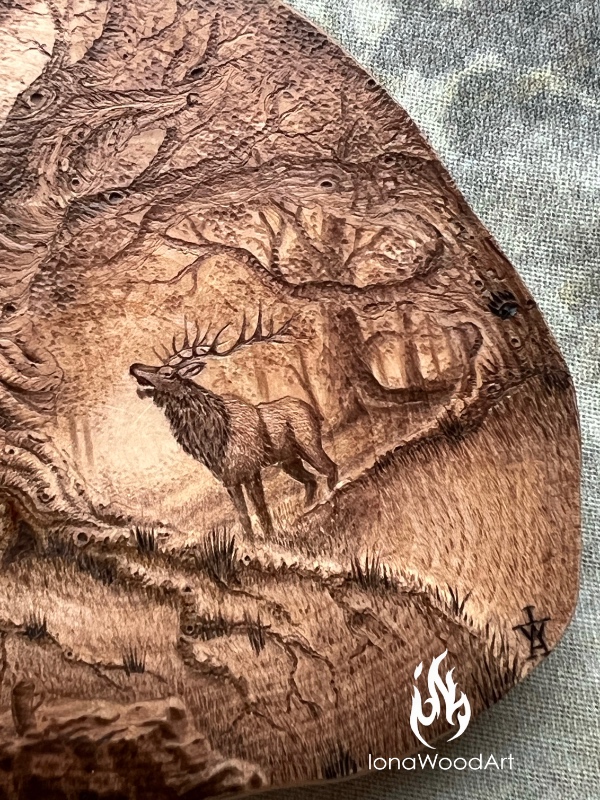
This artwork is my interpretation of the pre-Christian Hiisi. It was drawn from imagination and burned with a Razertip wood burner on a slice of burl birch about ten centimetres in diameter. I chose burl on purpose, allowing the wood’s natural shimmer and depth to become the forest’s light and atmosphere.
The wood is not a background. It is the environment itself. What appears as glow or depth was not added, because it already existed within the wood.
This piece is not just a forest scene. It is a threshold. A quiet window into Hiisi, the sacred forest that inspires me as an artist, and the sacred place I live in.
Elements
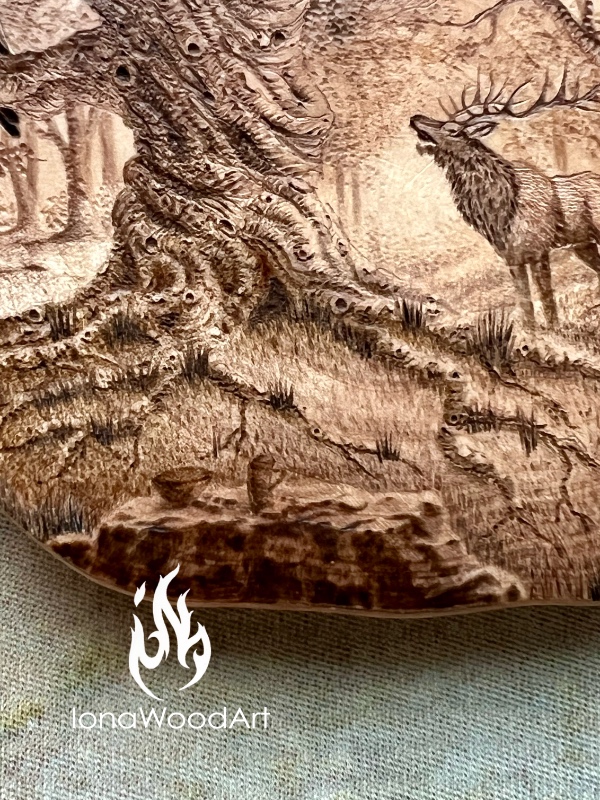
In the foreground of this work stands an uhrikivi. In English this is often translated as an offering stone, but it is not a sacrificial altar in the Christian sense.
In old Finnish belief, an uhrikivi marked a place where people acknowledged the power of the land, often within a Hiisi, a sacred forest that did not belong to humans. These stones were not built or placed. They were already there, discovered rather than created.
Small offerings were left quietly to maintain balance. It was a way of saying, “I see this place. I pass with respect. I take nothing without leaving something.”
The foreground of the artwork needed a grounding presence, and the uhrikivi felt right. The horn cup, bread, bowl, and bone are not meant as spectacle, but as quiet details. Simple gestures of acknowledgement.
Elk and Raven
Why an elk? In some old folklore, Hiisi is described as the origin or keeper of hoofed animals such as elks and horses. Later, after Christianity – in my opinion – ruined the image of Hiisi being a scared place, the sacred elk was also transformed, reimagined as something monstrous and chaotic.
I am not interested in that later image. This work returns to an older understanding of Hiisi as sacred land itself, alive and watchful. A place that exists on its own terms.
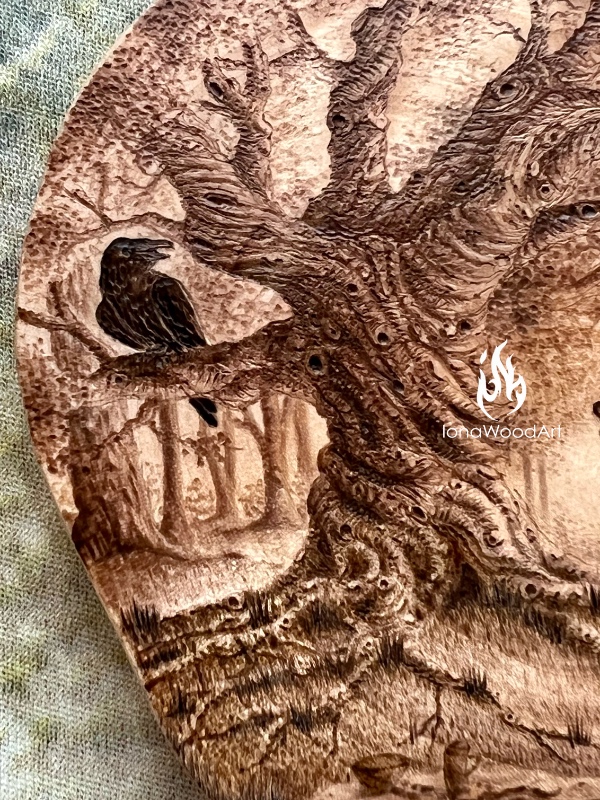
And the Raven? In pre-Christian belief connected to Hiisi, the Raven is not a bird of death. It is a bird of awareness, memory, and thresholds. A watcher. A witness.
Completing the artwork
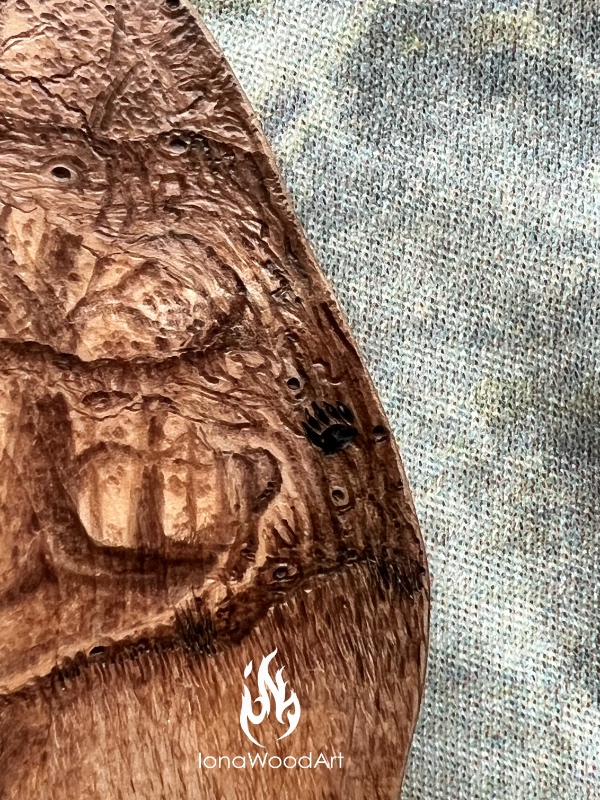
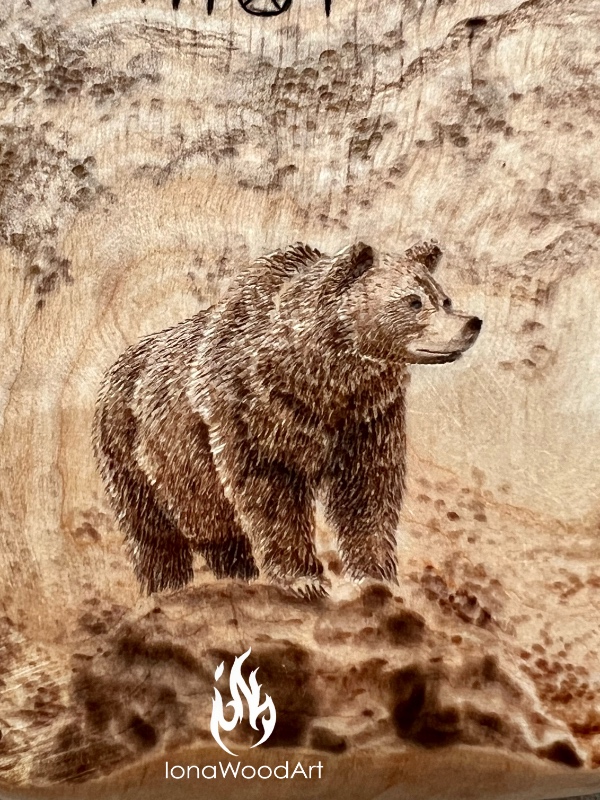
The grain of the backside of this Hiisi artwork was too pretty to leave be or to only burn a title into. What I saw when I stared at it, was a frame in the curvy burl grain, a frame of trees providing a window into … the past, perhaps.
In pre-Christian belief, the bear was thought to have descended from the sky, sent down by the sky god Ukko. When he walked the land, he carried that sacred origin with him.
Otso belongs in a Hiisi because he embodies the authority of the forest, without ruling it. Where Otso is present, humans are no longer central.
Otso becomes the silent witness; the keeper of what the front of my artwork does not show; a presence you discover ONLY if you turn the piece around. That is exactly how the bear exists in folklore. Rarely seen. Always felt.
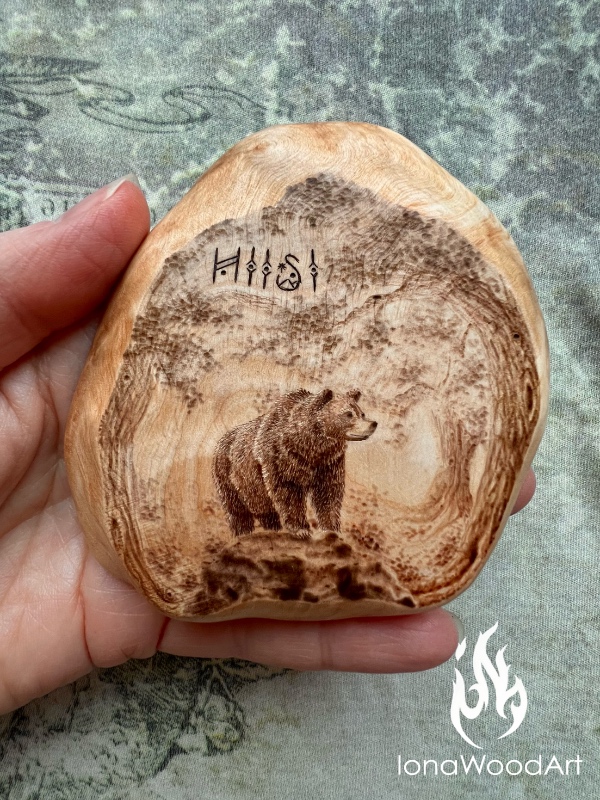
Now the artwork feels complete. The front is the forest, sacred and watchful, how I imagine (a) Hiisi would look like. The back is the memory of the forest, hinting to even older and quieter, realm. Less detailed, more suggestive, adding a beautiful contrast to the overall design!
Mythology
I didn’t begin with mythology. I began with place. Only later did I realize that many of the forms appearing in my work; the animals, the forest moods, the sense of threshold .. already belonged to the old stories of this land. My inspiration and wood art didn’t come from studying myth; the myth helped me understand what my wood art had been responding to all along.
Looking back, many of my larger pieces from recent years, the fox, the raven, the wolf, along with forest themed pendants and my way of burning gnarly old trees, suddenly formed a clear pattern. I am not illustrating mythology, and I am not following a concept. I simply have been responding to where I live.
Plans for 2026
What I’m interested in now is not recreating mythology, nor adopting any labels or belief systems. I’m interested in learning more and most importantly, I’m interested in listening, like I have been doing all these years. To the land, to the wood in my hands, to the grain.. to my inspiration and what’s in my heart.
This way of working will continue into 2026. Alongside these “slightly larger than pendant” pieces, I do also have plans for a series of mythology inspired pendants. Of Hiisi pendants. Small thresholds carried close to the body. Each one rooted in forest, place, and presence, rather than illustration or symbolism.
Not only Finnish mythology
At the same time, I am also careful not to place too much emphasis on specific mythology. While these stories matter to me, I do not want the work to require cultural knowledge or belonging in order to be felt. You do not need to be Finnish, or live in Finland, to recognise a Hiisi. The experience of sacred land, of old forests, of animal presence (spirit animals) and quiet thresholds exists across cultures.
By keeping the work open and grounded in place rather than doctrine, the pieces can speak to anyone who has ever felt something ancient and watchful in nature, whether they name it or not.
So, … if there is a thread running through my work, it is not of history and mythology. It’s not even spirituality. Staying long enough in one place .. patterns reveal themselves. I walk the same forest paths. I work with local wood. I pay attention to what keeps returning to my hands, letting material, environment, and lived experience quietly guide what appears … The thread in my work is relationship. My relationship to the natural world I am surrounded by.
Seen this way, my work in 2026 is not changing direction.
It is revealing one.